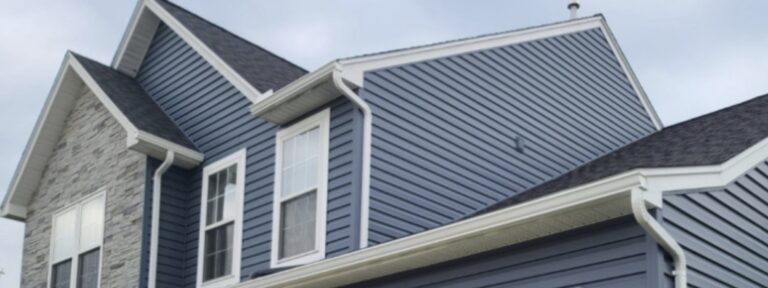
A useful gutter winter checklist starts with what you can safely see from the ground: loose gutter sections, recurring overflow, disconnected downspouts, and the places that iced up last winter. Record where water travels and where trouble returns. Those observations help a professional determine whether the next step is gutter replacement, downspout work, qualifying gutter protection, or a Niagara Thaw Systems assessment.
You do not need to diagnose the entire building before calling. Knowing which corner overflows, which downspout freezes, or which gutter repeatedly holds ice is a good starting point. The aim is to describe the problem clearly before freezing weather makes it harder to observe.

Why inspect the drainage path before freezing weather?
Western New York winter does not stay frozen from beginning to end. The National Weather Service’s Buffalo climate narrative describes cold, snowy conditions interrupted by thaws and rain. A gutter system therefore has to manage water between storms as well as during rainfall in autumn.
Follow the route in your mind: water reaches the gutter, moves toward an outlet, travels down the downspout, and leaves through a discharge point. A visible problem at one point may affect the rest of that route. A gutter that appears reasonably straight from the driveway can still have an outlet or downspout issue that needs closer inspection.
This check is not a promise of an ice-free winter. It is a way to separate an existing drainage or installation concern from a recurring freezing concern. Those may call for different work, and adding a winter system without understanding the gutter’s condition can miss the reason water is collecting.
A ground-level gutter winter checklist
Walk around the home in daylight when the ground is safe. Keep clear of overhead ice, falling debris, and visibly loose components. Do not climb a ladder, lean out of a window, or stand beneath an unstable gutter to get a better view.
- Look for a dip, a bowed section, or a gutter pulling away from the house.
- Note leaking corners, separated joints, or a downspout that appears disconnected.
- Look for leaf buildup you can already see without reaching into the gutter.
- Check whether the downspout outlet or above-ground extension is visibly damaged or out of position.
- Record staining, peeling paint, or damaged exterior wood around the gutter attachment area.
- Identify the exact locations of last winter’s heavy icicles, frozen downspouts, or repeated gutter ice.
A photograph taken from a safe location can help explain a concern. Include enough of the building to show which side or corner you mean. You do not need an overhead close-up or a photograph taken during dangerous weather.
If you cannot see inside the gutter, leave that part of the checklist unanswered. Lack of a visible obstruction is not proof that the gutter is clear, correctly pitched, or properly fastened.
Watch the system during ordinary rain
If conditions allow, observe the problem from a sheltered, safe location during ordinary rain. Water spilling over one section may point toward a different issue than leakage at a corner. A downspout that discharges normally while another does not is useful information, although it does not establish the cause by itself.
Write down whether the problem occurs only during heavier rain or also in lighter weather. Note whether it starts near a valley, a corner, an outlet, or a long gutter run. Avoid assigning a cause such as ‘undersized gutter’ before someone has checked the layout and condition.
Also look at where the discharge goes. An extension that was moved during yard work may no longer be directing water as intended. If water backs up from an underground connection, describe that separately: work beyond the gutter and downspout system may require another contractor.
What a professional assessment reviews
A professional can inspect details that a ground-level check cannot settle. Niagara Gutter evaluates gutter condition, measurements, pitch toward the outlets, fastening, and downspout sizing and placement as part of planning an appropriate project.
The attachment surface matters too. Fascia or related exterior wood that is damaged may need attention within the gutter project before new components are installed. Niagara performs appropriate fascia, soffit, rafter-tail, and related exterior wood work, but does not represent itself as a roofing, plumbing, or underground drainage contractor.
The recommendation should match the concern. An aging system failing in several places may warrant seamless gutter replacement. Existing gutters being considered for Alu-Rex gutter protection should be inspected for suitability first. Cleaning or preparation may be part of qualifying guard work; Niagara does not offer general standalone gutter cleaning.
When to ask about Niagara Thaw Systems
If gutter ice or a frozen downspout keeps returning at the same location, describe that pattern when requesting an estimate. Include whether it occurs after a thaw, during prolonged freezing weather, or when you first notice water failing to drain. You do not have to identify the exact weather mechanism to request an assessment.
Niagara Thaw Systems uses professionally installed heat cable focused on the gutter and downspout drainage path. Its purpose is to help create and maintain a route for meltwater during freezing conditions and reduce recurring gutter ice and related stress on gutter components.
Heat cable is not a substitute for sound gutters or a complete fix for every cause of winter ice. Property conditions and electrical requirements need individual evaluation. Necessary electrical work belongs with an appropriately qualified contractor. Do not expect every trace of ice to disappear or treat the system as a roof-repair service.
What to include in your estimate request
A short, specific description is more useful than a guessed solution. For example: ‘The rear gutter overflows near the left outlet in rain, and that same downspout froze last winter.’ That tells the estimator where to start without committing you to a particular product.
Include the property location, the affected building side, any safe photographs, and whether the concern is new or recurring. If several buildings are involved, identify the trouble spots separately rather than assuming they all need the same treatment.
Niagara Gutter primarily serves Niagara and Erie Counties. The office gathers project information and routes inquiries to the appropriate salesperson. Installation scheduling depends on weather and project conditions, so requesting an estimate before winter does not guarantee installation before a particular storm.
Plan the next step while the problem is easy to describe
Keep your observations together and update them if another rainfall reveals something different. That record helps turn a general concern about winter into a more useful conversation about the gutter and downspout system.
For a property-specific recommendation, call 716-695-3500 or request a free estimate. Mention Niagara Thaw Systems if recurring gutter ice or frozen downspouts are the main concern.